

Sermons
 Several years ago, Sarah and I worshiped at the Washington National Cathedral, located about five miles to the northwest of the Washington Monument: that soaring-in-the-sky monument that if it was put on its side, could nearly fit in its entirety inside our massive national cathedral. Now, safe to say, the church architecture may not be quite as warmly inviting to everyone nowadays. It is a Gothic stonework structure with over a century of history. For some tourists to the capital, it is beautiful and wondrous, even captivating for some who take a tour of the building or sit in on a concert. For others, it can be a little intimidating, almost symbolizing an almighty all-powerful God, that you better do everything you possibly can in your life to not anger whatsoever.
Now, just to let you know, and this may just reveal how nerdy the pastor is, but every once in a while when I struggle getting our youngest one to sleep, I will watch the recording of their previous Sunday’s worship, because every once in a while, I like to see how they do worship. And before every service, without fail, the lead pastor, will stand before the assembly, a collection of tourists and members who have been there for decades, and he will re-iterate over and over again, that “wherever you come from, this is your cathedral, and that you are always welcome here for worship, to come by and just pray, to feed whatever your soul needs.” And with every time he does that, I like to think not only does the building become slightly less intimidating, or to move others away from marveling over the architecture alone, and instead marvel over the grace of God.
But, again, several years before, Sarah and I ventured to that place of worship during the summer, when not as many were filling the sanctuary space, as if even the Washington National Cathedral isn’t beyond the struggles of plenty of other churches nowadays; and so they had us sit in the area up front where the choir would often sit. So, just as a reminder with some Catholic or Episcopal cathedrals, there are the standard pews and then you get to an open elevated area, where sometimes the altar would be, but then behind are these pews on both sides facing each other, where again, the choir would sit during the worship.
So, on that summer Sunday, it was a bit awkward, to say the least, to sit up there. That isn’t what we envisioned was going to be our experience that morning. But, oddly enough, it was rather moving to see the faces on the other side: the faces of other tourists like us, the faces of worship leaders, the faces of those, you could just tell, something was on their mind, the faces of those who were holding back tears as we sang a hymn, the faces of others looking around, perhaps wondering what it was all for, the faces of when, sharing the peace with complete strangers, that there was added joy unleashed in a simple handshake, as if the very peace of Jesus Christ could be exchanged even when not knowing a single thing about the other child of God on the receiving end.
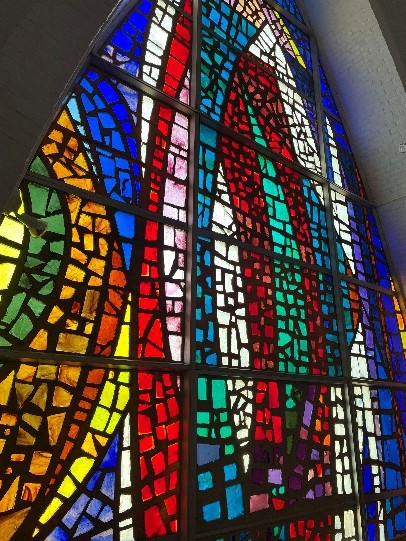
Now, one of the most beautiful parts of the cathedral, as with many church buildings, is the stained-glass window above the doors where you enter into the holy space, but also the same doors when you depart into what God insists is just as holy of space on the outside. I think about that with this stained-glass window in our chapel space, that is also perhaps one of the most beautiful parts of this building, one of which we can easily overlook every time we enter and depart this space. But in that majestic artwork, is a reminder of the holiness God sees in us brought together to form a breath-taking hope, even amidst our brokenness.
As if we, with our ragged edges of past mistakes and imperfect shapes of spiritual life and worn down from whatever life has thrown at us, God insists on bringing us together in this space and otherwise, to form a Divine masterpiece. And that, even if we look at ourselves and others, and only see the brokenness, God, instead, sees just as much beauty as the most toured-through cathedral. It is God’s re-vamped story of our human condition that has been going on long before the earliest construction crews for sanctuaries and altar spaces: that even the disciples with their share of raggedness and imperfections galore, not only did God see beauty in each of them; God saw the faces of those who could help bring the very peace and love of Jesus Christ to further life for those desperately searching for it.
And that masterful, breath-taking story continues in each of you. You are the disciples called out to harvest seeds of joy and an awareness that the Gospel is still fully alive and well, and it’s not reserved for the biggest of cathedrals, but out there, too; so that all may be fully assured that no matter how broken someone might feel, that nothing will ever be able to separate them, or any of us, from the love of God, in Christ Jesus, our Lord. So, for that Greatest News for all of us, we most certainly give thanks to God, indeed! Amen!